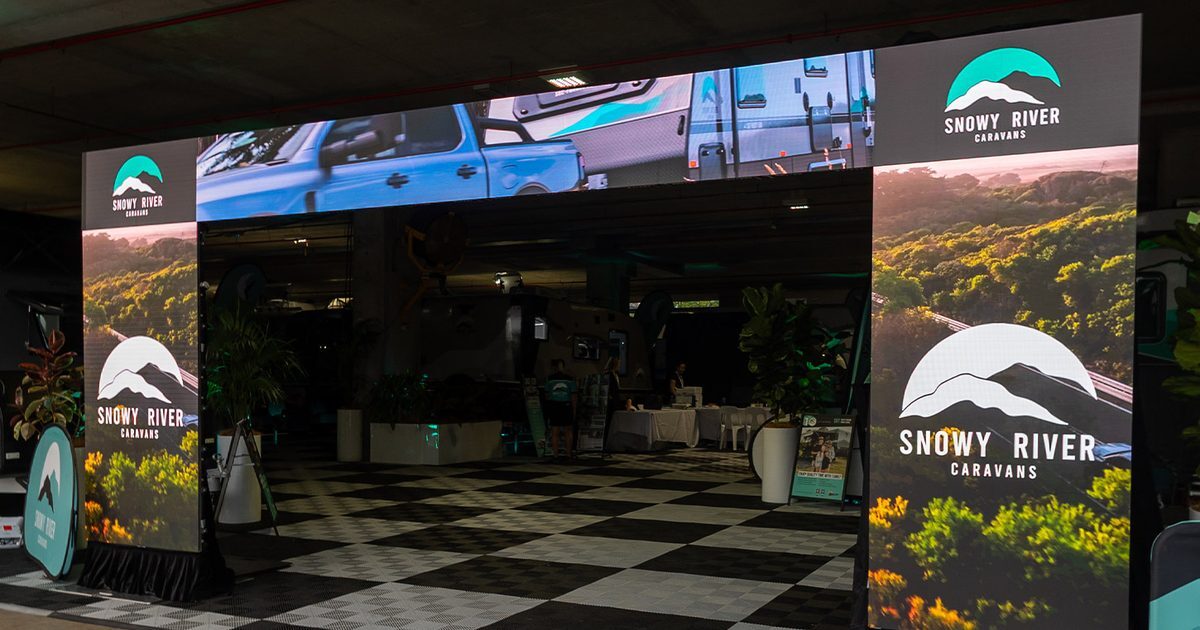
Every expo floor is the same experiment: a room full of brands, each with a small window of time to catch a visitor's eye before that visitor moves on to the next stand. The difference between a brand that holds attention and one that gets walked past is often not the pitch or the product. It is what the stand looks like from ten metres away.
An LED wall is one of the highest-impact investments a brand can make in an expo or trade show stand. It gives your brand a physical presence bigger than the footprint you paid for. It brings motion into a floor of static competitors. And it lets your brand run visual content at the resolution and colour fidelity your marketing team designed for. This is a practical guide to why LED walls work for expos, how they scale to different stand sizes, and what to plan for before you book.
Key takeaways
- LED walls give expo stands the two things that most reliably attract attention: scale and motion.
- They scale down to compact configurations for smaller stands, not just the huge builds at the front of the hall.
- Content is at least as important as the wall itself. Short loops with clean brand-first design outperform complex video every time.
- Technical planning (floor weight limits, power, hanging points and set-up times) needs to happen early. Exhibition halls have strict access windows.
- Coordination with the stand builder and exhibition organiser matters more here than at any other event type. Start those conversations at the brief stage.
The attention economy of an expo hall
Walk any exhibition hall at the Brisbane Convention & Exhibition Centre, the Gold Coast Convention and Exhibition Centre or anywhere else, and you will see the same pattern. Visitors move down aisles at a steady pace, scanning stands with a few seconds of attention each. What they stop for is what stands out visually. Static signage, however well designed, competes with everything else in a hall full of static signage. Motion breaks that pattern. Scale breaks that pattern. Something bright and dynamic at eye level does the same thing a shop window does on a busy street.
An LED wall is the most direct answer to this pattern. It is bright enough to compete with venue lighting. It is high enough resolution to carry detailed brand content clearly. It moves, which stops the eye. And it gives your brand a physical presence larger than the stand itself, because a well-placed LED wall reads at a distance the way a billboard does.
An expo floor is an attention economy. The brands that win are the ones that stand out from ten metres away, not the ones with the best pitch at the desk.
Why LED walls work for expo stands
Beyond the raw attention capture, LED walls do several specific things well in an exhibition environment:
- Brand-accurate colour. LED technology reproduces brand colours precisely, unlike projection which is affected by ambient hall lighting. Your brand palette is your brand palette on the wall.
- Bright enough for a lit hall. Exhibition halls have strong overhead lighting. LED walls are self-illuminating and remain vivid regardless of ambient light. Projection washes out in these conditions. Our LED screens vs projection guide compares the two in more detail.
- Motion without complication. Product demonstrations, brand videos, animated logos, testimonials, live camera feeds all display cleanly with no black screens between transitions.
- Professional presence. A well-executed LED wall signals that the brand is at the expo seriously. It reads as an intentional investment, which changes how visitors approach the stand.
Sizing and configuration options
LED walls at expos are not one-size-fits-all. The most common configurations are:
- Full back wall. LED panels forming the entire back wall of a stand, typically 3 to 6 metres wide. High impact, ideal for feature stands or a product launch on the expo floor.
- Freestanding centrepiece. A stand-alone LED wall positioned at the front or centre of the stand. Effective when the back wall is used for other purposes (product displays, meeting areas).
- Stand-integrated panels. Smaller LED sections built into the stand architecture: a strip above the entrance, a portrait panel by the product display, a header running across the top.
- Curved and creative configurations. Panels shaped to follow architectural curves, corner installations, tiled walls with layered content zones. Higher build cost, distinctive visual result.
Sizing is driven by stand dimensions, budget, sightlines from the aisle, and how the content is designed. A 2-metre-square LED wall on a 3x3 stand can be as impactful as a 6-metre wall on a corner build, if the content is designed properly for the size.
Technical considerations before you book
Six things to line up early. The exhibition environment has less flexibility than most event venues.
Floor loading
LED walls have weight. Exhibition halls have floor load ratings (the weight the floor can safely carry) that vary by venue and location within the hall. Your stand builder or venue operations team needs to confirm the intended LED wall footprint is within limits.
Power supply
LED walls draw meaningful power. Exhibition stands are usually supplied with a fixed power allocation; larger walls may need an upgraded supply. This must be arranged with the exhibition organiser in advance.
Rigging vs freestanding
Some configurations hang from overhead rigging points (fixings in the venue roof structure); others sit freestanding on structural frames. Not every stand build supports rigging. Confirm before finalising the design.
Bump-in and pack-down windows
Exhibition venues run tight bump-in schedules (the set-up window before the show opens). LED walls need dedicated setup time within the window your stand build occupies. Coordination between stand builder, AV supplier and venue is essential.
Content specifications
LED walls have specific resolution and aspect ratios (the screen's width compared with its height). Content produced for standard 16:9 screens (the widescreen TV shape) may need to be reformatted. Get the technical specs from the AV supplier before your creative team starts on content.
Content playback source
A media server (a computer built to play video reliably all day), a laptop, a dedicated playback device, or a live camera feed. Each has different strengths in reliability and flexibility, so agree with your AV supplier which suits your content.
What content works best on an expo LED wall
The wall is only as good as what plays on it. A few principles that consistently outperform complex or overproduced content:
- Short loops. 15 to 60 seconds, repeating. Visitors watch for a few seconds; anything longer means most people never see the full sequence.
- Brand-first design. Logo prominent, colour palette consistent with your brand system, minimal text. The wall should be recognisable as your brand from across the hall before anyone reads a word.
- Mix static and motion. Full motion for the full loop is exhausting to watch and expensive to produce. A static hero image with subtle motion elements (a moving logo, a scrolling tagline, animated highlights) is often more effective and more affordable.
- Consider live content. A live camera feed of demonstrations or presenter segments turns the wall from marketing display into event content, which draws deeper engagement.
"Our stand isn't big enough for an LED wall"
A common assumption, and usually wrong. LED walls scale down to configurations that suit compact stands (3x3 metre stands and even smaller) without losing impact. A 1.5-metre LED panel used as a stand centrepiece can be as attention-grabbing as a 6-metre wall on a larger build, because the visual density of the content still stands out from the surrounding static signage.
The relevant question is not "is my stand big enough" but "does my stand have space for a well-placed LED panel that will read from the aisle?" For most stands, the answer is yes. The configuration might be a stand-integrated portrait panel, a compact freestanding wall, or a smaller header display rather than a full back wall, but the LED option is on the table.
A well-placed 1.5-metre LED panel can outperform static signage on a stand three times the size.
Working with your stand builder and the exhibition organiser
Expo AV is one of the few event types where three parties need to be coordinated tightly: your AV supplier, your stand builder, and the exhibition organiser. Each holds different pieces of the puzzle. The stand builder controls the physical structure. The organiser controls the venue rules, power, and access windows. The AV supplier delivers the wall and the content. Nothing goes cleanly unless the three are talking to each other early.
The most useful thing you can do as a brand or marketing lead is to introduce the parties to each other at the brief stage, not the week before bump-in. Share the stand builder's design with the AV supplier. Share the AV requirements with the exhibition organiser. Confirm floor loading, power, and rigging permissions with everyone in the same conversation. Advance coordination is where expo AV either works smoothly or turns into a bump-in day crisis.
What to lock in early
- LED wall size and configuration, agreed with the stand builder.
- Floor loading confirmed with the venue for your stand location.
- Power supply upgrade arranged with the exhibition organiser if needed.
- Rigging permissions confirmed if overhead installation is required.
- Content produced to LED wall specifications, not standard screen ratios.
- Bump-in window agreed between stand builder, AV supplier and venue.
Frequently asked questions
Are LED walls worth the investment for a trade show stand?
For brands where stand impact and lead conversion matter, yes. LED walls give your stand two things that reliably attract attention in a busy hall: scale and motion. The relevant comparison is not against static signage but against the cost of an under-performing expo presence: stand space paid for, staff time invested, opportunities missed. For any brand serious about their expo return, an LED wall is one of the highest-impact production investments available.
Can an LED wall fit on a small expo stand?
Yes. LED walls scale down to compact configurations for stands as small as 3x3 metres, sometimes smaller. A well-placed 1.5-metre LED panel used as a stand centrepiece or header display can be as attention-grabbing as a full back wall on a larger build. The right question is not whether your stand is big enough, but which LED configuration suits the stand you have.
What content works best on an expo LED wall?
Short loops (15 to 60 seconds), brand-first design (logo prominent, minimal text, consistent colour palette), and a mix of static and motion elements rather than full-motion video for the full loop. Live content (a camera feed of demonstrations or presenter segments) can turn the wall from marketing display into interactive event content. Content should be produced to the LED wall's specific resolution and aspect ratio.
Who arranges the LED wall - the stand builder or an AV supplier?
Usually an AV supplier, with the stand builder integrating the LED wall into the physical stand design. Coordination is essential: the stand builder needs to know the wall specifications early so the structure supports it, and the AV supplier needs the stand design early to plan the install. Some stand builders offer LED as part of their service; dedicated AV suppliers generally deliver better content quality and more configuration flexibility.
How early do I need to book LED wall hire for an expo?
Three months out is a reasonable starting point for a standard configuration. For larger expos with high demand on venue power, rigging or specific LED types, book earlier. Content design should start at the same time as the booking so it is ready and tested before bump-in. The most common cause of expo AV problems is late booking, which limits both configuration options and content-testing time.
Planning an expo stand in Brisbane?
An LED wall on an expo stand is not decoration. It is one of the most direct answers to the attention problem every exhibiting brand faces: how do you stand out from ten metres away, in a hall full of brands trying to do the same? At any scale, from a compact centrepiece to a full back wall, the technology consistently outperforms static signage in the two ways that matter most on a busy floor: scale and motion.
If you are planning an expo or trade show presence in Brisbane or across South East Queensland, we would be glad to talk through what LED wall configuration would suit your stand and your brand.