
"Should we go with an LED wall or a projector?" is one of the most common questions we get during the AV brief stage. It's also one where the wrong answer can quietly undermine the whole event.
For most modern corporate events, LED is the right answer. For some specific situations, projection still wins. This guide walks through the trade-offs in plain English, with a comparison table, the scenarios where each one is the right fit, and the single most common mistake we see in the brief stage.
Key takeaways
- LED walls outperform projection in almost any room with ambient light, which is most corporate venues.
- Projection is still the right call for very large throw distances (where the projector sits a long way from the screen) and tightly controlled lighting environments.
- LED has a higher upfront cost. Reliability and image quality usually justify it.
- The most common mistake: choosing projection for a product launch in a venue with windows.
- Sizing depends on viewing distance and content type. A short conversation with your supplier sorts this out faster than a guess.
The short answer
LED walls are the default for most corporate events in Brisbane in 2026. They're brighter, sharper, more reliable, and they look modern. Projection still has a place, but the situations where it's genuinely the better choice are narrower than they used to be.
If you're briefing a conference, product launch, awards night or expo, the question isn't usually "LED or projection". It's "how big an LED wall, in what configuration, and what content runs on it". Projection is the right answer for specific situations, which we'll cover below.
How each technology actually works
An LED wall is built from individual LED panels that fit together like tiles. Each panel emits its own light, so the picture is bright, sharp and visible even in well-lit rooms. Panels are modular, so the wall can be configured to almost any size or shape.
Projection bounces a beam of light from a projector onto a screen or surface. Image quality depends on the brightness of the projector, the size of the projected image, the throw distance (how far the projector sits from the screen), and crucially, how dark the room is. The brighter the room, the more the projected image washes out.
| Factor | LED Wall | Projection |
|---|---|---|
| Brightness in lit rooms | Stays crisp under stage lighting and ambient light. | Washes out if the room isn't well-controlled. |
| Image sharpness | Sharp and consistent. Holds brand colours accurately. | Sharp in dark rooms. Softens as ambient light increases. |
| Size and shape | Modular. Any size or configuration, including non-standard shapes. | Limited to standard screen shapes. Larger images need brighter projectors. |
| Throw distance | Not a factor. LED sits flush against any wall or stage. | Projector needs distance from the screen. Limits venue layouts. |
| Upfront cost | Higher per square metre. | Generally lower for large images. |
| Reliability | No lamp to fail, and the picture doesn't drift out of alignment during the event. | Lamp can fail or dim. Image can shift if anything moves. |
When LED is the clear choice
Three scenarios where LED is the right answer almost every time:

- Your venue has ambient light you can't fully control. Most function rooms, ballrooms and conference venues sit here. Even with the lights dimmed, projection struggles. LED stays crisp.
- Your event depends on sharp brand visuals. Product launches and expos live or die on how the product looks on screen. LED holds brand colours accurately and looks clean in any video capture.
- Your audience is large and the screen needs to be readable from the back of the room. LED brightness scales without the image softening the way projection does.
When projection still works
Projection isn't obsolete. There are still situations where it's the right call:
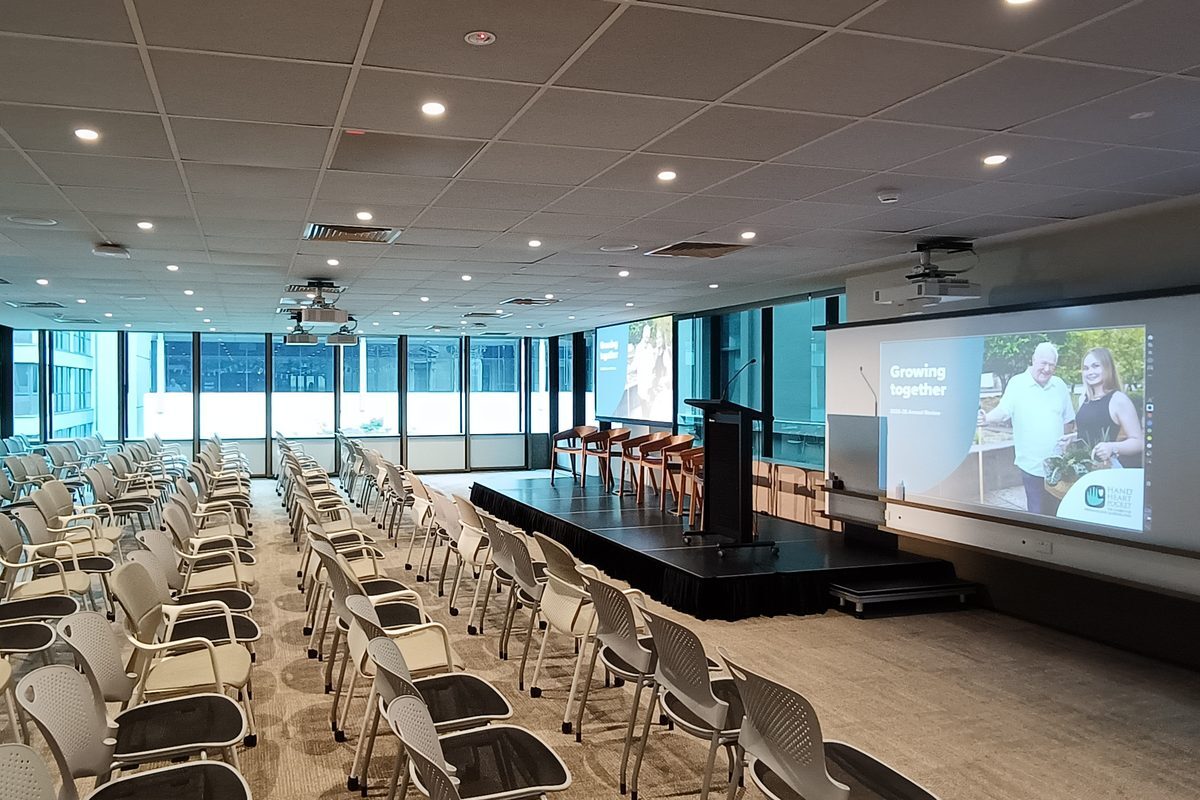
- Very large throw distances. In some larger venues, the image area needed is so big that LED would require an enormous panel count. Projection can cover the same space at a lower cost.
- Tightly controlled lighting environments. Theatres, auditoriums and rooms designed for darkness give projection the conditions it needs to look sharp.
- Budget is the constraint and image quality is a secondary priority. Internal training sessions, smaller meetings and lower-stakes events where the screen is functional rather than featured.
For very small events (under roughly 50 people in a contained room), a large LCD or OLED screen (essentially a big TV on a stand) is sometimes the most practical option. They sit between LED and projection on cost, work in any lighting, and are simple to set up. We hire 65-inch and 75-inch screens for exactly this.
The reliability factor
One reason LED has taken over corporate AV is reliability. A projector has a lamp that can fail or dim over the course of an event. The image can shift if anything moves the projector or screen. The picture can also drift out of focus or alignment as the room warms up.
LED has none of these failure modes. Panels have no lamps or moving parts, the image stays consistent across a long day, and if a single panel ever fails (very rare), it can usually be swapped out without taking the whole wall down. For high-stakes events where the screen has to keep working from doors open to the final session, this matters.
The most common mistake we see
It's a specific one: choosing projection for a product launch in a venue with windows.

The brief looks reasonable at sign-off. The venue is striking. The projector is bright enough on paper. Then doors open in the late afternoon, the western sun pours through the windows, the projected image goes from "premium reveal" to "faded slide". By the time the lights come down to fix it, the room has already formed its impression.
If your venue has windows that can't be fully blacked out, brief for LED. The cost difference is significantly smaller than the cost of a product launch that lands flat.
How to think about LED wall sizing
The full sizing answer depends on room dimensions, audience layout, viewing distance and content type. Your supplier will run the numbers properly. Two general principles to brief with:
- Viewing distance shapes resolution requirements. Closer audiences need finer pixel pitch (the spacing between LEDs). Audiences further back can comfortably use lower-resolution panels.
- Content type shapes scale. Static slides need less screen area than video content. Brand reveals and product imagery need more.
Provide your supplier with room dimensions, audience size, and a sense of the content. They'll come back with options. Our corporate AV hire guide covers what else to include.
Quick decision guide
- Lit room, modern event, brand visuals matter: LED.
- Dark theatre or auditorium, large image area, tight budget: projection.
- Outdoor or daytime event with any ambient light: LED.
- Internal training, small meeting, basic slides: projection or a large TV screen.
- Product launch in a venue with windows: LED.
- Mixed-use venue and you're not sure: ask your supplier to brief both options against your actual room.
Frequently asked questions
Is LED better than projection for events?
For most modern corporate events, yes. LED outperforms projection in any room with ambient light, holds brand colours more accurately, and is more reliable across a long event. Projection still wins for very large throw distances and tightly dark environments.
How bright does an LED wall need to be?
Most indoor corporate LED walls run between 800 and 1,500 nits (nits are the unit for screen brightness), which handles standard function-room lighting comfortably. For outdoor or daytime events, you'll want significantly brighter (often 4,000+ nits). Your supplier will spec the right brightness for your venue and event timing.
Can I use projection outdoors?
In daylight, no. Outdoor projection only works after dark, and even then needs a very high-brightness projector and a controlled screen surface. For daytime outdoor events, LED is the only practical option.
How big does my LED wall need to be?
It depends on your room dimensions, audience size, viewing distance and content type. Provide those to your supplier and they'll come back with options. As a rough start point, main conference stages often use walls between 4 and 8 metres wide. Product launches sit similar. Gala stages depend on the staging layout.
Why is LED more expensive than projection?
The panels themselves are more expensive to manufacture, and a wall needs more structural support to set up safely. The trade-off is image quality, reliability and a modern look that fits today's corporate events. For most events, the gap is smaller than people expect once full quotes are compared like-for-like.
Need help deciding on screen technology for your event?
LED versus projection is a real decision but not a difficult one once the trade-offs are clear. LED is the right call for most modern corporate events. Projection still has a place for specific situations. The best way to land the call is to brief your supplier on the venue, the audience and the content, and let them sense-check both options against your actual conditions.
If you're planning an event in Brisbane or anywhere across SEQ and want to talk through the right screen technology for your room and budget, we'd be happy to help. Share your venue, date and event format and we'll come back with a recommendation that fits.